
How separating from your partner affects tax
Getting divorced or separating from your partner can be a difficult time and it’s understandable that you may not be thinking about tax. But any changes in your personal circumstances can change what tax you pay.
Here, we’ll take you through what you need to know – so you can sort everything early on and stop any unexpected bills or complications later.
Tell us about your separation straightaway
If you divorce, separate or stop living with your ‘spouse’ (the name for your married partner) or partner, you need to let us know as soon as it happens. This is because it could affect your tax code, meaning you could pay too much or too little tax and end up with a bill.
You can let us know about a change in your relationship status and update your details quickly on GOV.UK.
Cancel your Marriage Allowance
If you were claiming Marriage Allowance, you’ll need to cancel it. Marriage Allowance lets one spouse or partner share part of their own tax-free Personal Allowance with the other (if they’re not using it all themselves) – saving a couple up to £252 a year in Income Tax. You can learn more on our Marriage Allowance page.
Once you divorce, or permanently separate, you’ll no longer be able to claim this allowance.
Cancelling quickly matters – if you delay telling us, your tax code could be wrong and you could face a surprise bill later.
Either you or your partner can cancel your Marriage Allowance:
- online via your Personal Tax Account on GOV.UK
- by calling us on 0300 200 3300 (Monday to Friday, 8am to 6pm)
Key thing to remember:
Let us know about your divorce or separation as soon as you can. This can stop you getting any unexpected tax bills.
Transferring assets between you: Capital Gains Tax
When you separate, you’ll need to work out who gets the things you owned together – like a home, savings or shares. This process of dividing up your shared belongings is called ‘transferring assets’.
Sometimes, transferring assets involves paying something called ‘Capital Gains Tax’. This is a tax on the profit you make when the item you’re selling or transferring has gone up in value. You can learn more about Capital Gains Tax on our page about selling assets.
Key thing to remember:
If you have a formal divorce agreement, any assets included in the agreement can be transferred between you without needing to pay Capital Gains Tax. This is called a ‘no gain, no loss’ transfer, and there’s no time limit on when the transfer takes place.
However, if you don’t have a divorce agreement, you need to transfer any assets within 3 years of the end of the tax year in which you separated. After this point, the person transferring the asset may need to pay Capital Gains Tax.
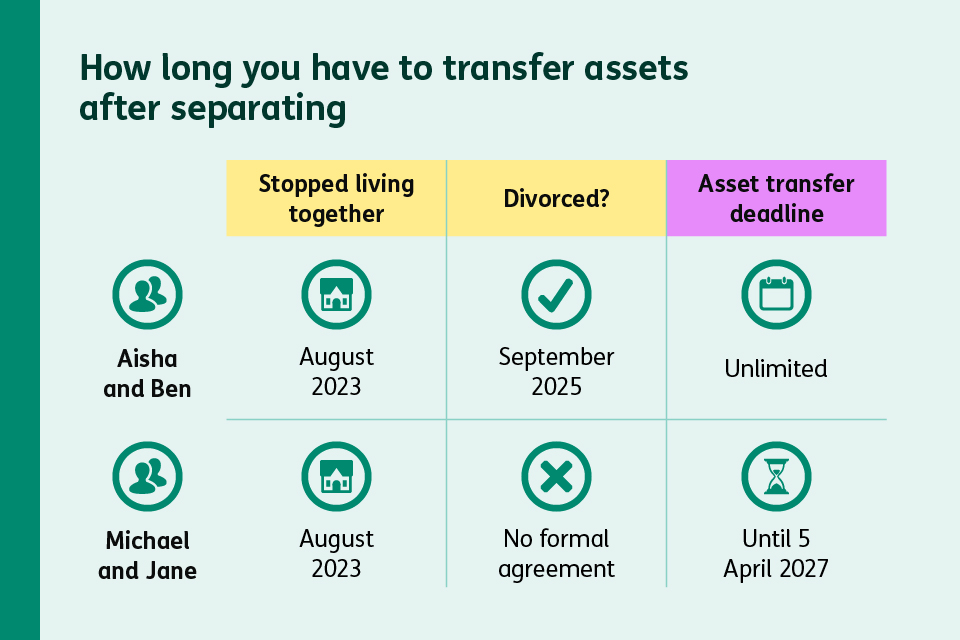
Here’s an example.
Aisha and Ben stopped living together in August 2023. (That’s the tax year that ended 5 April 2024).
They signed their formal divorce agreement in September 2025.
They have an unlimited time period to transfer any assets listed in the agreement.
Here’s another example.
Michael and Jane also stopped living together in August 2023.
They chose to not get a formal divorce agreement.
They have until 5 April 2027 to transfer any assets, before needing to think about Capital Gains Tax.
You can find more about transferring assets and Capital Gains Tax on GOV.UK, and you can always speak to a tax advisor about your specific situation.
Maintenance payments aren’t taxed
If you pay or receive maintenance payments following a divorce or separation, the tax situation is usually straightforward:
- the person receiving maintenance doesn’t pay Income Tax on it
- the person paying maintenance can’t claim tax relief on it
We’re here to help
Separation can be a stressful time for everyone involved, but hopefully this information has helped you feel a bit more confident about the tax side of things.
If you need any more help or information, you can find a step-by-step guide on handling your finances and tax when you divorce or separate on GOV.UK.
Tell us what you think
We welcome your input to help us improve this website. Please take a few moments to complete our short website feedback survey about your experience.
The survey is anonymous, does not collect personal information, and consists of five optional rating questions.