
How tax works in your first job
Starting your first job is an exciting time. From remembering everyone’s name, to figuring out how the coffee machine works, you’ll have a lot to think about.
Tax probably won’t be top of your list, but it’s worth getting your head around it as it will feature on your first payslip. You’ll also need to understand what National Insurance is and how it works – and get your own National Insurance number. Find out how to do this on GOV.UK.
Once you know the basics, it’s a lot simpler than you might think.
When you’ll start paying Income Tax
Most people are allowed to get a certain amount of money each year, tax-free. This is called your Personal Allowance and it’s currently £12,570 a year.
If your total income for the year is more than your Personal Allowance, you’ll pay tax on the bit of money that’s above it. The rates you pay are separated into ‘thresholds’. A threshold is simply a financial limit.
Here’s how the different rates of Income Tax work.*
| Your income | Your Income Tax rate |
|---|---|
| Up to £12,570 (your Personal Allowance) | 0% |
| £12,571 to £50,270 | 20% |
| £50,271 to £125,140 | 40% |
| Any income above £125,140 | 45% |
*Income Tax rates for England, Wales and Northern Ireland.

Helpful tip:
You’ll only be taxed the higher rate on the amount of money that’s above each threshold, not your total income.
If you live in Scotland, these figures will be different. You can find out more about Income Tax in Scotland on GOV.UK.
To help you understand how Income Tax works in the real world, here’s an example:
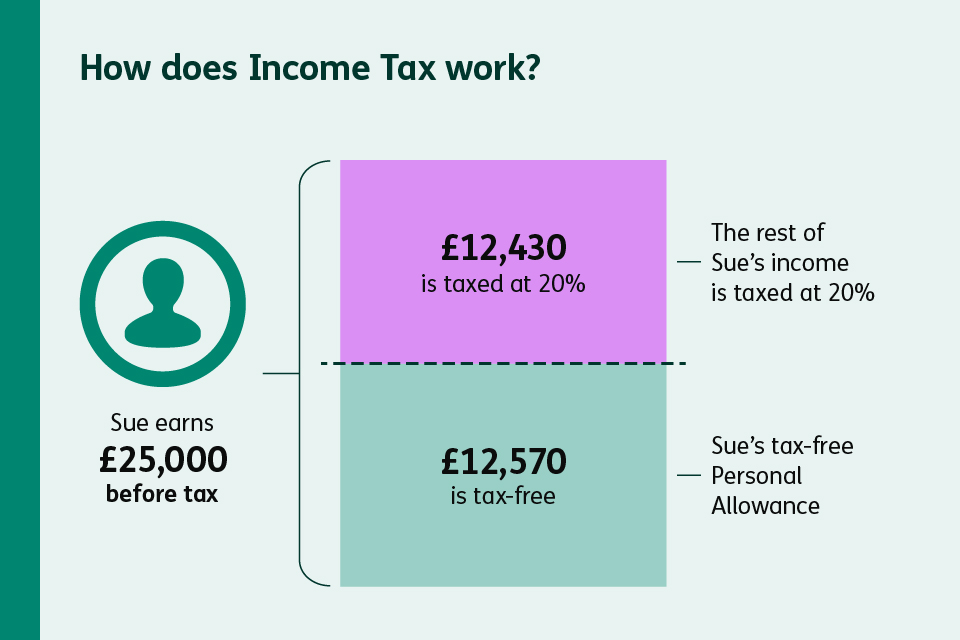
Sue earns £25,000 a year.
She has a tax-free Personal Allowance of £12,570, so she won’t pay any tax on that chunk of money.
The remaining £12,430 will be taxed at 20%. This means she’ll pay £2,486 in Income Tax, leaving her with £9,944.
By adding together £12,570 and £9,944, this means that – after Income Tax, Sue has £22,514.
However, Sue’s take-home pay for the year will be a little less than that, as she also has to pay things like National Insurance and her workplace pension. We’ll explain how that works later.
Your employer will handle things for you
When you’re paid your first wages, you’ll probably notice that some of your money has been taken to cover things like Income Tax, National Insurance and pensions. We call these ‘deductions’ and there’s nothing to worry about.
Your employer has simply taken any money you owe us before paying you.
What is National Insurance?
You pay National Insurance in something called ‘contributions’. It helps fund benefits we all use, like the NHS and the new State Pension.
You start paying National Insurance if you’re:
At least 16 years old
And earning above £242 per week or £1,048 per month
When you get your first employed job, it’ll be automatically taken from your wages, as well as Income Tax.
Helpful tip:
You’ll be able to clearly see how much Income Tax and National Insurance have been taken as they’ll both show up on your payslip.
Check out our National Insurance page to learn more about how it works.
Getting to know Pay As You Earn (or PAYE for short)
The system your employer will use to take any deductions from your wages is called ‘Pay As You Earn’, or PAYE for short. It makes life a lot easier for you as everything is handled by your employer.
They’ll use PAYE to:
Work out how much tax and National Insurance you owe
Take the money from your wages before you get paid
Send the money to us

For most people in their first job, PAYE takes care of everything. Unless we get in touch, you shouldn’t need to do anything or make any separate tax payments.
Your all-important tax code
Everyone has a tax code. It’s a mix of letters and numbers which your employer uses to help them work out your tax.
It shows them:
- how much you can earn each year, tax-free (your Personal Allowance)
- how much money to take from your wages if you earn above that amount
You’ll see your tax code shown on every payslip.
You can find out more on our Understanding your tax code page.
Key thing to remember:
Our HMRC app is also a great source of info. You can check your tax code, National Insurance number, employment history and much more. Find out how to download it on GOV.UK.
What your payslip shows you
Every time you’re paid, you’ll be given a payslip. It may be a paper one or a digital document.
It’s a bit like the receipts you get when you buy something. It’ll show you how much money you’ve earned, and how much has been taken off in tax and National Insurance.
You’ll see:
- your tax code
- your gross pay (that means your pay before any tax has been taken)
- any Income Tax and National Insurance taken off
- your net pay (this is the amount you actually get paid)
It’ll also show any money you’ve paid into a workplace pension.
It’s a good idea to check your payslip to make sure everything looks right. If something seems a bit odd, talk to your employer.
Helpful tip:
Keep your payslips somewhere safe. You might need to look back at them later on if you have questions about your pay, how much tax has been taken, or your tax code.
Emergency tax codes are quite normal
On your first payslip in a new job, you may see that more tax has been taken than you expected. That probably means you’ve been put on an emergency tax code.
Don’t be alarmed – it’s a normal process and nothing to worry about. It just means that your employer doesn’t have all your tax information yet.
They still need to pay you, so they use an emergency code, which means a bit more tax is taken than necessary. If you’ve overpaid tax, you’ll get it back as a refund later.
3 things you need to know
- In your first job – or first day in a new job – you may be given an emergency tax code.
- It’s only temporary and will switch to the right code as soon as we have all the right tax info for you.
- You’ll get your money back – usually you’ll be paid more on your next payslip, or you’ll get a straight refund from us.
You may find it useful to use our starter checklist on GOV.UK to make sure your new employer has all your details before your first payday. They can then put you on the right tax code from the start.
When to think about tax returns
You may have heard about doing something called a ‘tax return’. This is the way we ask some people to let us know how much income they get each year. It’s mainly for:
- self-employed people – like freelancers who work for themselves
- people who get money from things other than their job, like investments or renting out a property
If you’re starting your first job and it’s your only source of income, you probably won’t need to think about it.
However, if you do get any income that’s not being taxed through PAYE, you’ll need to let us know by doing a Self Assessment tax return or by using our Making Tax Digital for Income Tax system.
Take a look at our Self Assessment and Making Tax Digital for Income Tax pages to find out how.
It’s normal for your tax to change
If you look at your payslip and see that the amount of tax and National Insurance you’re paying has changed, don’t worry. Over the course of your working life, this might happen for lots of different reasons, like:
- your hours have changed because you’ve worked overtime
- you’ve been given a pay rise
- you started or stopped another job
- we updated your tax code
- you got a one-off payment, like a bonus or some back pay
- you got money from something other than your job
We (or your employer) will always let you know about any changes to your tax code.
If something doesn’t look right on your payslip, talk to your employer.
7 key things to remember:
- Tax and National Insurance is usually taken automatically through PAYE.
- Your tax code shows your employer how much tax to collect.
- Most people can earn £12,570 a year, tax-free.
- Emergency tax codes are temporary and very common.
- Tax returns are usually for self-employed people – most people in their first job don’t need to do it.
- If you pay too much tax, you’ll get it back.
- If something looks wrong, speak to your employer first.
Entering the world of work is an exciting and challenging time. Get ahead of the game by knowing what to look out for when you start getting paid. It’ll help you feel more confident when you see your first payslip. You can find out more about starting a new job on GOV.UK.