
Tax when you buy a home
Buying a home and making it your own is an exciting moment in life. The last thing you want is any unexpected costs.
One cost that not everyone knows about when buying a home is called Stamp Duty Land Tax. You may also hear people call it Stamp Duty or SDLT.
It can sound confusing at first, but it’s straightforward once you know a bit more about it.
Will you have to pay it?
Stamp Duty Land Tax is a tax you pay to the government when you buy property or land.
For most people, if your home costs less than £125,000 you don’t pay any Stamp Duty Land Tax at all.
If it’s over £125,000, you only pay tax on the bit that’s above that amount.

If you’re buying an additional or buy-to-let property, or are a non-UK resident, you’ll pay tax on the whole of the purchase price.
Things work differently in Scotland and Wales
Stamp Duty Land Tax doesn’t exist in Scotland or Wales.
In Scotland you pay a Land and Buildings Transaction Tax (LBTT) instead, and in Wales it’s a Land Transaction Tax (LTT).
They’re a similar idea but have different rates and thresholds.
You can check out the rules on buying a property in Scotland on GOV.SCOT and find out about the Land Transaction Tax in Wales on GOV.WALES.
More expensive homes have higher rates
It helps if you think of the value of your home as a staircase. Each Stamp Duty Land Tax threshold is a step. The more your home is worth, the higher up the staircase you are – and the higher tax rate you pay.
As we said earlier, for most purchases, the first tax-free ‘step’ is £125,000. If your home is worth less than £125,000, you don’t pay any Stamp Duty Land Tax on it.
For the next £125,000 step after that – when your home is worth between £125,001 and £250,000 – you pay 2% Stamp Duty Land Tax on the amount of money between £125,001 and £250,000. The first £125,000 of its value is tax-free.
Not every ‘step’ is the same size, but it’s still a handy way to think of it. As you climb up the steps, the higher tax rate only applies to the amount of money on that particular step.
This table helps to explain it:
| Home value | Stamp Duty Land Tax rate |
|---|---|
| Up to £125,000 | 0% |
| The next £125,000 (the portion from £125,001 to £250,000) | 2% |
| The next £675,000 (the portion from £250,001 to £925,000) | 5% |
| The next £575,000 (the portion from £925,001 to £1.5 million) | 10% |
| The remaining amount (the portion above £1.5 million) | 12% |
Here’s an example of how it works:
Let’s imagine you’re buying a home for £295,000 and you’re not a first-time buyer.
The first £125,000 of that £295,000 has no Stamp Duty Land Tax.
Next, we look at the rate for the next step (or threshold). For the bit between £125,001 and £250,000, you pay Stamp Duty Land Tax at a rate of 2% – which works out as £2,500.
Next, we look at the rate for the third step. For the bit between £250,001 and £925,000, you pay Stamp Duty Land Tax at 5% on the amount of the purchase price that falls within this band. That’s £45,000 – which works out as £2,250.
£2,500 plus £2,250 is £4,750. So that’s how much Stamp Duty Land Tax you’d pay.

If that still sounds complicated, don’t worry. You can use our free Stamp Duty Land Tax calculator on GOV.UK to see exactly what you would pay.
First-time buyers get extra help
If you’re buying your first home, you get something called ‘First-time Buyers’ Relief’.
This means that you don’t pay any Stamp Duty Land Tax on the first £300,000 of your home’s purchase price.
If the price is more than £300,000, you’ll pay Stamp Duty Land tax at a rate of 5% on anything between £300,000 and £500,000.

Key thing to remember:
First-time Buyers’ Relief can only be used on first homes worth up to £500,000. So, if your first home costs more than that, you have to pay the normal Stamp Duty Land Tax rates we mentioned above. You also may not get First-time Buyers’ Relief if you or someone you’re buying with has owned a home before.
You pay more tax on second homes
If you already own a home and you’re buying another property (like a holiday home or a place to rent out) that’s worth more than £40,000, you have to pay extra on top of the normal Stamp Duty Land Tax rates.
Here’s an example.
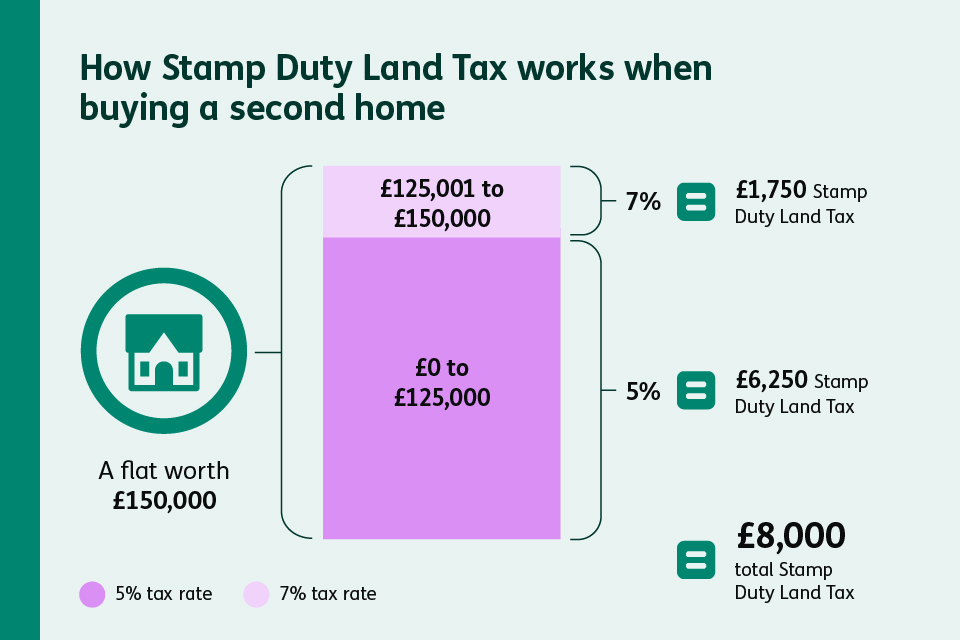
Karen already owns a home. She buys a second flat for £150,000.
She’ll pay 5% Stamp Duty Land Tax on the portion up to £125,000. That’s £6,250.
And 7% on the portion between £125,001 and £150,00, which works out at £1,750.
So in total she’ll pay £8,000.
Helpful tip: The rules are a little different if you’re a non-UK resident. You can find out more on GOV.UK.
Getting professional help
When buying a home, most people use a ‘solicitor’ or ‘conveyancer’ to deal with the legal paperwork and any moving around of money that’s involved.
Your solicitor may offer to handle your Stamp Duty Land Tax as part of the sale. If they do this, they’ll send us the right forms, ask you for any tax you owe, and then send this money on to us. This all needs to be done within 14 days of you buying your property.
Remember, even if your solicitor handles this, it’s still up to you to make sure everything is done correctly and on time.
Sometimes the rules are different
There are some situations which change how much Stamp Duty Land Tax you owe.
When buying a home, you can buy the freehold or the leasehold. Freehold means you own the building and the land it sits on. Leasehold means you own the land and buildings but only for a set period of time.
If you’re buying the lease of a home rather than the freehold, different rates of Stamp Duty Land Tax may apply. You can find more information on GOV.UK.
You can also buy a home through a ‘shared ownership scheme’. That’s where you buy part of the home and pay rent on the rest.
In this case, you’ll have a choice about whether to pay Stamp Duty Land Tax on the full purchase price, or on the portion you’re buying. You can find out more about shared ownership on GOV.UK.
And if you become the owner of the home through a divorce or separation, you might not pay any Stamp Duty Land Tax at all.
Plan ahead so there are no surprises
Helpful tip:
When working out how much you can afford to spend on a home and how much it will cost you to move, don’t forget to include Stamp Duty Land Tax.
In such an exciting but busy time, it can easily get forgotten. So why not use our free Stamp Duty Land Tax calculator on GOV.UK before you start house hunting. Then you’ll know where you stand.