
Tax and the Winter Fuel Payment
The Winter Fuel Payment (or the Pension Age Winter Heating Payment if you live in Scotland) is a type of extra financial support from the government. It’s a one-off payment each year to help older people with their heating bills during colder months.
If you receive it, you might be wondering if it affects how much tax you need to pay. The answer is it all depends on your total income.
Just so you know, we’ll use ‘winter payment’ throughout the rest of this page, but the same info applies if you get the Pension Age Winter Heating Payment instead. Let’s get into it.
The payment depends on your income
The government looks at each person’s income to work out if they qualify to keep the benefit or need to repay it.
Key thing to remember:
If your total income is below £35,000 in a tax year, you’ll get a winter payment of between £100 and £300 automatically – and it’s yours to keep. You won’t need to pay any tax on it. If your total income is £35,000 or more in a tax year, you’ll need to repay the winter payment through your Income Tax.
You can usually repay it automatically, we’ll explain how this works later. Or you can choose not to receive the winter payment instead – we’ll get into that too.
We only look at your individual income, not your household’s combined income. So, we’ll assess you and your partner separately if you both receive it.
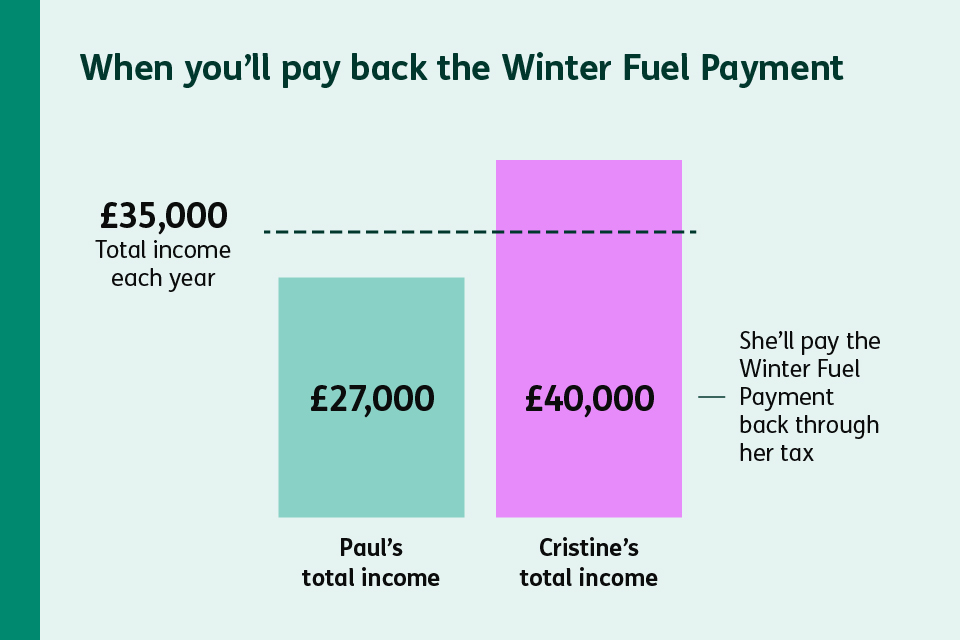
Here’s an example.
Paul’s total income is £27,000.
Cristine’s total income is £40,000.
They both receive the winter payment.
Paul will keep his, tax-free.
Cristine will need to pay hers back through her tax.
You can check whether you’ll need to pay it back on GOV.UK.
Paying it back automatically through PAYE
Pay As You Earn (or PAYE for short) is the system your employer or pension provider uses to take any deductions from your wages or pension before you’re paid them.
If your income comes through PAYE and is above £35,000, we’ll simply adjust your tax code to collect the right amount automatically. This usually works out as a small monthly charge, and there’s nothing else you need to do.
Paying it back through Self Assessment
If you send us a Self Assessment tax return, you’ll need to make sure you include the winter payment.
Helpful tip:
The winter payment needs to be included in the ‘Winter Fuel Payment (WFP)’ and ‘Pension Age Winter Heating Payment (PAWHP)’ charge section of your tax return. If you send your tax return online, it should show up automatically, but if it’s missing, you’ll need to add it in yourself.
Remember, you only need to pay it back if your total income is above £35,000 a year.
You can choose to opt out
If your total income is consistently above £35,000, you can choose to stop receiving the winter payment altogether. This means you won’t have to remember it on any tax returns or see your tax code change each year.
How you opt out depends on where you live:
- in England, Wales or Northern Ireland: use the opt out form on GOV.UK
- in Scotland: contact Social Security Scotland on mygov.scot
Want to know a bit more?
For a step-by-step overview, check out our winter payment video on YouTube.
If you’re in England, Wales or Northern Ireland, you can find out more about the Winter Fuel Payment as well as other heating support on GOV.UK.
If you’re in Scotland, find more information about the Pension Age Winter Heating Payment and other help for heating costs on mygov.scot.
Tell us what you think
We welcome your input to help us improve this website. Please take a few moments to complete our short website feedback survey about your experience.
The survey is anonymous, does not collect personal information, and consists of five optional rating questions.