
Selling goods abroad as a small business
Trading with customers in other countries (which is commonly known as exporting) can be a great way to grow your business.
Whether you’re selling handmade jewellery to France, shipping car parts to Canada or offering craft supplies to Australia, the global market opens up exciting new opportunities.
Selling abroad does come with some additional rules (sometimes these are called going through ‘customs’). On this page, we’ll help you get to grips with what you need to know about exporting from Great Britain (that’s England, Scotland and Wales).
If you’re trading from Northern Ireland to the EU specifically, things can be different – including the VAT (Value Added Tax) rules. You can find more about charging VAT on goods sent to the EU from Northern Ireland on GOV.UK.
You’ll need an EORI number
An EORI number is your business’s ID for international trade – think of it like a passport for your business. It stands for an Economic Operators Registration and Identification number. It allows us to track and identify businesses when they sell and send goods to different countries.
If you’re based in Great Britain, you’ll need an EORI number starting with ‘GB’. If you’re based in Northern Ireland and trading with countries outside the EU, you may need an EORI number starting with ‘XI’.
Helpful tip:
Applying for an EORI number
You can get an EORI number for free in just a few minutes on GOV.UK. You’ll need this information to hand:
- your Unique Taxpayer Reference (UTR) number (you can find this on GOV.UK, the HMRC app or any letter from us)
- your business start date (you can find this at Companies House)
- your Standard Industrial Classification (SIC) code (you can find this at Companies House too – it simply shows what type of business you have)
- your VAT number if you’re VAT registered (you can find this on your VAT registration certificate)
- your National Insurance number if you’re an individual or sole trader (you can find this on the HMRC app)
Helpful tip:
It’s best to apply before your first international shipment. Without it, your goods could get stuck at the border and be delayed.
You’ll fill in an export declaration
When you send anything abroad, you’ll need to fill in a form called an ‘export declaration’. You’ll need to let us know (this is the ‘declaring’ part) what the item is, and a bit about where it’s going and where it’s come from.
It can feel like quite a lot of information at first, but it’s to make sure that whatever you’re selling has a smooth journey across the border to your customer. So, it’s very important you fill this in right and on time.
You can find out everything you need to make a full export declaration on GOV.UK.
Helpful tip:
You can hire someone else to help manage this side of your business. Find out more about getting someone to deal with customs for you on GOV.UK.
There are special rules for some goods
Certain products need extra documents before you can export them. This includes things like:
- food and drink
- plants
- animals
- artwork and antiques
- chemicals
- medicines
Key thing to remember:
If your product falls into one of these categories, you need to check what licences, certificates or other documents they need before you ship them. There can be serious penalties for getting this wrong.
You can find out more about exporting military goods, software or technology on GOV.UK.
For most everyday items, like clothing, crafts or general household items, you won’t need any special licences.
But you should check if your goods need any extra documents on GOV.UK before you export them.
You don’t need to charge VAT
This may surprise you, but if you’re VAT-registered and export goods to customers outside the UK, you usually do something called ‘zero-rate’ them. This means you don’t add VAT to the price. If you’re not VAT-registered, this doesn’t apply as you don’t charge VAT.
Key thing to remember:
Your customer abroad pays the amount you’d normally charge for the item, without the 20% UK VAT.
Here’s an example.
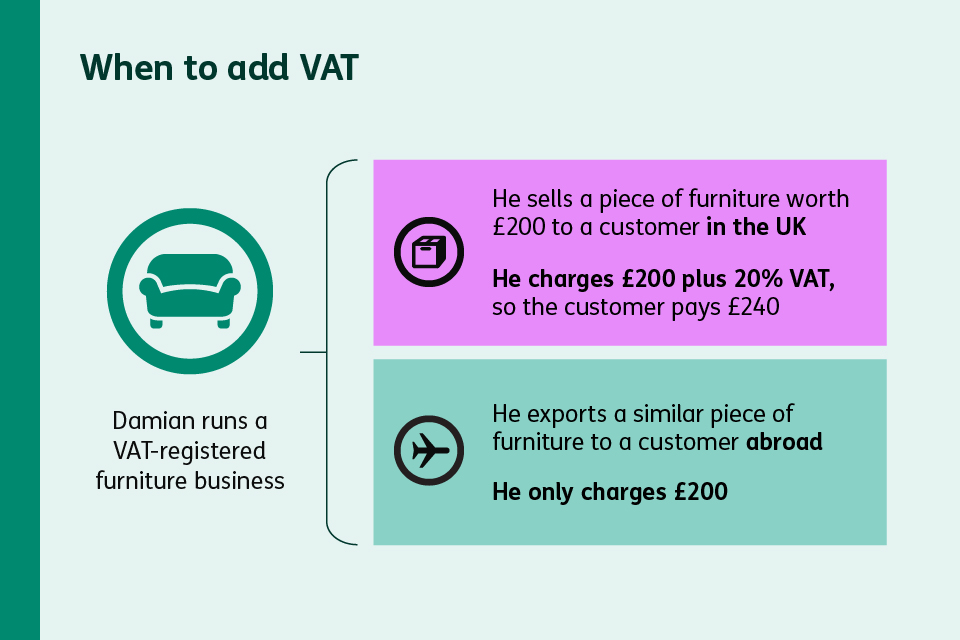
Damian runs a VAT-registered furniture business.
He sells a piece of furniture worth £200 to a customer in the UK.
He charges £200 plus 20% VAT, so the customer pays £240.
Damian exports a similar piece of furniture to a customer abroad.
He only charges them £200.
Key thing to remember:
You can only ‘zero-rate’ something if you’re VAT-registered and have proof that the goods you sold actually left the UK.
What counts as proof you sold abroad?
If you use a courier like DHL or FedEx, they’ll give you tracking numbers and shipping documents. These count as proof your item left the UK. If you post items using Royal Mail, keep your certificate of posting or the dispatch pack receipt from Parcelforce.
Key thing to remember:
You’ll need to make sure you get this evidence within 3 months of the sale date.
Without proof that your goods left the UK, you could end up having to pay back the VAT you didn’t charge your customers – which can be an unwanted and expensive surprise.
Helpful tip:
Taking photos of any proof of postage, shipping documents and receipts as soon as you get them can save you a lot of hassle in the long run.
You still need to pay Income Tax
Although you don’t need to add VAT onto international sales, you’ll still need to pay Income Tax. Any money you make from selling abroad counts as taxable income, just like if you sold to UK customers.
Key thing to remember:
You’ll need to include any international sales as part of your business’s income on your tax return, along with any other money you make.
One thing to watch out for – if you’re paid in a foreign currency, you’ll need to convert it to British pounds for your records. Use the exchange rate from the date of the sale or when you were paid (you can use rates set by banks or on xe.com).
Helpful tip:
Keep a note of which rate you used and where you got it from for your records.
Keeping clear records is very important
You’ll need to keep copies of your invoices, sales records and any communication you’ve had with your customers. Many small business owners find that an online spreadsheet is a useful way to track international sales.
Key thing to remember:
You need to keep all your export records for 6 years.
Check out our tips to keep good records on our record-keeping page.
Get started in a few steps
Selling goods abroad can feel intimidating at first, with all the different things to track and record. But thousands of UK small businesses do it successfully every day. The key is to take it step-by-step, rather than trying to learn everything at once.
Step 1: Start by getting your EORI number sorted.
Step 2: Set up a simple record-keeping system that works for you.
Step 3: Check if your goods need any extra licences or documents.
Step 4: Make sure you’ve filled out and submitted your export declaration.
Once you’ve got all this in place, you’ll find the process becomes routine quite quickly.
You can find out more about selling and doing business abroad on GOV.UK. You don’t have to figure it all out alone – we’re here to help you get tax confident so your business can grow internationally.
Tell us what you think
We welcome your input to help us improve this website. Please take a few moments to complete our short website feedback survey about your experience.
The survey is anonymous, does not collect personal information, and consists of five optional rating questions.