
Tax codes and why they change
If you work for an employer, you’ll get a payslip whenever you get paid. One of the things you’ll see on there is your tax code. It’s a mix of numbers and letters that tells your employer how much tax to take from what you’ve earned, before you’re paid.
It’s an automatic system called ‘Pay As You Earn’ (or PAYE), and it all happens behind the scenes. You can find out more about how it works on our PAYE page.
Sometimes, your tax code might change. But don’t worry, that’s completely normal and usually just means that your financial situation has changed.
What to do if yours changes
When something happens in your life like you start a new job, get a pay rise or a company car – it can affect how much tax you pay. Your employer lets us know about this change, so we can update your tax code to fit your new situation.
In most cases, if your tax code changes, there’s nothing for you to do. It usually means that your employer has told us about the change, and our PAYE system has worked out how much tax they should now take from your wages.
Your tax code might also change if you get extra money that you weren’t getting before, like from:
- workplace or private pensions
- interest on savings
- changes to any work ‘benefits’ you have – like company healthcare
These are all normal life changes, and your tax code changes with them.

Key thing to remember:
The most common tax code is 1257L. This means you can make £12,570 a year before paying any tax. This is called your tax-free Personal Allowance and you can read more about it on this page.
Emergency tax codes
If your tax code changes to have a W1, M1 or X at the end, you’re on what’s called an ‘emergency tax code’. ‘Emergency’ makes it sound scary, but it’s nothing to worry about. It often means that we don’t have all the details we need about your situation just yet.
Emergency tax codes sometimes appear when you start a new job. It usually means that we’re waiting for some more leaving details from your old employer, or that you haven’t filled in the new starter checklist for your employer. You can see how to fill it in on GOV.UK.
If you’re on an emergency tax code, it can sometimes mean that you pay a bit more tax than you should at first. But don’t worry – once we’ve got all the info to set you up on the right tax code, you’ll be refunded any tax that you’ve overpaid.
Basic rate tax codes
If you have a second job, sometimes your tax code will just say BR. BR stands for ‘basic rate’.
Key thing to remember:
If you see this tax code on your payslip, it means all your wages from that job are being taxed at the basic rate of Income Tax, which is 20%. You don’t get a Personal Allowance – that’s the £12,570 you can earn without paying tax.
This is because you can only use your Personal Allowance for one job, so we give it to your main one. Your second job then gets taxed at the basic rate on every pound you earn.
Here’s an example:
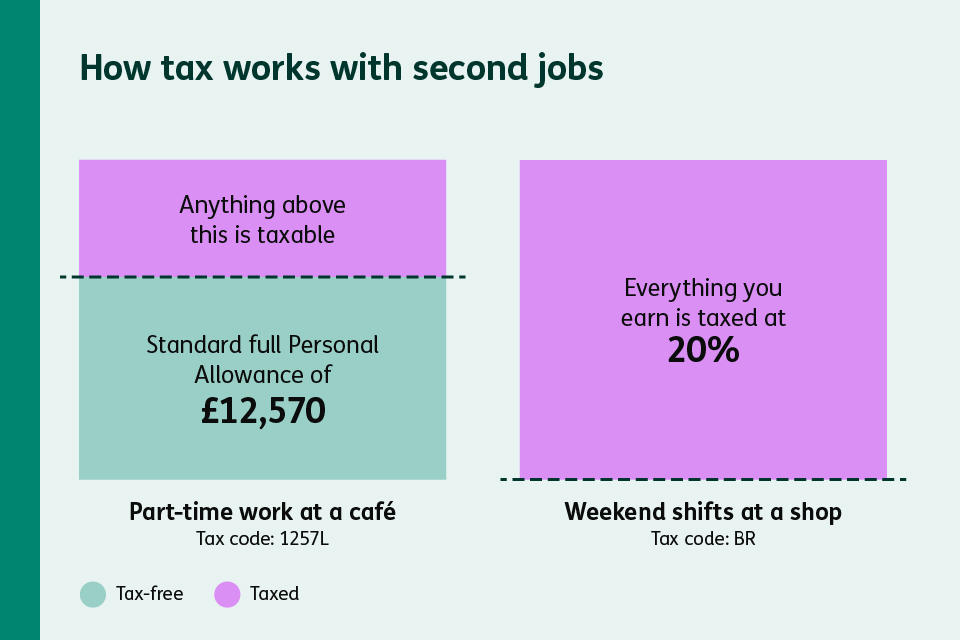
Imagine you work part-time at a café but also have weekend shifts at a shop.
Your café job might have the code 1257L, so you get the standard full tax-free Personal Allowance of £12,570 a year.
Your second job at the shop would then have a BR tax code, so everything you earn there is taxed at 20%.
If it wasn’t split this way, you could end up owing money at the end of the year.
You can check your tax code yourself
If you’re worried that your tax code is wrong, you can check it online on GOV.UK or on the HMRC app.
If it still doesn’t look right, let us know straight away and we can explain what it means or make any changes to get it right.
Getting the right tax back is easy
If we do find that you’ve been on the wrong tax code and have paid more tax than you should have, we’ll put things right by either reducing the amount of tax we collect from your future wages or letting you know how to claim back the extra tax you’ve paid.
You can check and claim for a refund online on GOV.UK, or on our app or by asking us to send you a cheque
The main thing to remember is that tax codes are there to help – not to catch you out. They make sure you pay the right amount of tax throughout the year, so there are no nasty surprises. And if they do change, it’s usually just the system doing its job.