
What is National Insurance?
You may have seen National Insurance on your payslip, or as part of your tax return and wondered what it is. Put simply, National Insurance helps to fund some ‘state benefits’. Let’s get into it.
National Insurance builds your State Pension
National Insurance isn’t like other taxes. You pay it in something called ‘contributions’.
Your contributions are logged over the years on your personal National Insurance record. Your record determines how much, if any, State Pension you’ll receive. This is an example of a ‘state benefit’ we mentioned above.
Key thing to remember:
You’ll normally need 10 qualifying years on your National Insurance record to receive some of the new State Pension. To find out how much State Pension you could get, you can check your State Pension forecast on GOV.UK.
If you have an online account, you can check your record any time on GOV.UK or on the HMRC app. If you don’t have either of these, you can ask for a statement of your National Insurance record on GOV.UK.
Helpful tip:
If you do have gaps in your record, you may be able to fill them with what we call ‘National Insurance credits’ – you can find out all you need to know on GOV.UK. If you can’t fill them with credits, any gaps that fall in the past 6 complete tax years can often be filled by paying something called ‘voluntary contributions’. Find out more on GOV.UK.
Everyone’s contributions help others too
Part of your National Insurance goes to help fund the NHS. The rest goes towards other state benefits. This includes financial support for people that need it, like people who are unemployed, off sick, or on maternity leave.
You only pay when you earn enough
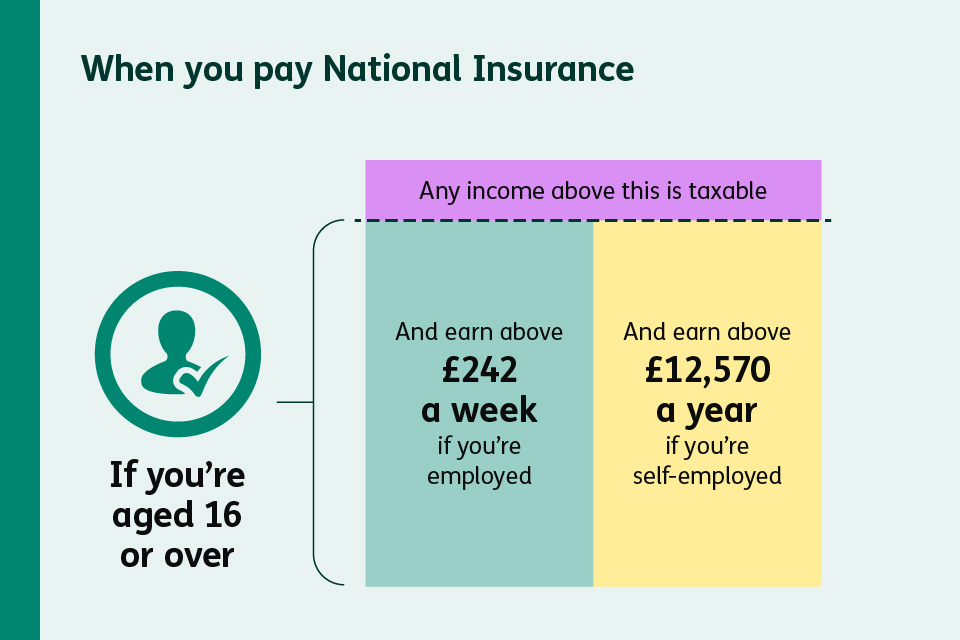
You only pay National Insurance if you’re aged 16 or over and earn above a certain amount. You start paying when you earn more than £242 a week from each job. If you’re self-employed, you pay when you earn more than £12,570 a year.
How you pay National Insurance
If you’re employed, you don’t need to do anything. Your employer will automatically take National Insurance from your wages before you’re paid. This is through a system called ‘Pay As You Earn’ (or PAYE). You may have seen these letters before on your payslips. You can find out more about how it works on our PAYE page.
If you’re self-employed, you pay any National Insurance you owe when you send us your tax return each year. Learn more about what this involves on our Self Assessment and Making Tax Digital for Income Tax page.
You can also find out more about paying National Insurance on GOV.UK.
You won’t pay National Insurance forever
It might be a while yet, but you’ll eventually stop paying National Insurance altogether. Find out how tax and National Insurance work after State Pension age on GOV.UK.
Your lifelong National Insurance number
Most people automatically get sent a National Insurance number when they turn 16. This number stays with you for every job you ever have, making sure all your contributions are recorded. Keep it safe because you’ll need it whenever you start a new job, as well as other things like applying for a student loan, benefits, and even registering to vote.
Helpful tip:
The easiest way to find your National Insurance number is on the HMRC app. It’ll also be on your tax returns – and may be on your payslip too.
Never had a National Insurance number? You can find out how to apply for one on GOV.UK.