
Self Assessment if you're self-employed
When you work for yourself, the way you pay tax is different to working for an employer. You may need to send us something called a Self Assessment tax return.
In a nutshell, it’s a way to let us know how much money you’ve made that year, so we can make sure you pay the right amount of tax and National Insurance, at the right time.
With Self Assessment, you only need to complete one tax return each year to cover all your income – whether that’s from self-employment or other things, like renting out a property or getting interest from savings and investments.
Need to know:
If you’re a sole trader, or make money from property, the way you send us information about your income is changing. It’s called Making Tax Digital for Income Tax. For some people that change starts from April 2026.
You can find out who needs to use Making Tax Digital, when you might need to start using it and how you can get ready for it on our Making Tax Digital for Income Tax page.
Helpful tip:
The tax year runs from 6 April one year to 5 April the following year.
Letting us know your income
Your tax return should include all the information about your income, including money you get from:
- self-employment
- renting out property
- interest on savings
- dividends
- workplace or private pensions
If you’re self-employed, you can also include anything you’ve spent on running your business – like stationery or office furniture. These are called your business expenses.
Helpful tip:
You can find out more about what counts as a business expense on GOV.UK.
When you do your tax return you’ll include all your income and all your business expenses – you’ll then see how much tax you owe for that tax year.
If you have to complete a tax return, you’ll need to register first. We’ll explain more about this in the next section.
When to register for Self Assessment
If you’re self-employed you may need to complete a tax return – whether you’re a plumber, hairdresser, freelance designer, or any other kind of sole trader. You can check if you need to register for Self Assessment on GOV.UK.
If you want to claim business expenses against any tax you owe, pay your National Insurance contributions voluntarily or to report a trading loss, you will need to register for Self Assessment on GOV.UK.
Key thing to remember:
You’ll only be taxed on your profit after expenses, which is why logging your business expenses on your tax return is important. Just make sure you keep receipts of everything you spend on running your business over the course of the year.
Let us know online by 5 October
You need to tell us on or before the 5 October after the end of the tax year if you need to file a return.
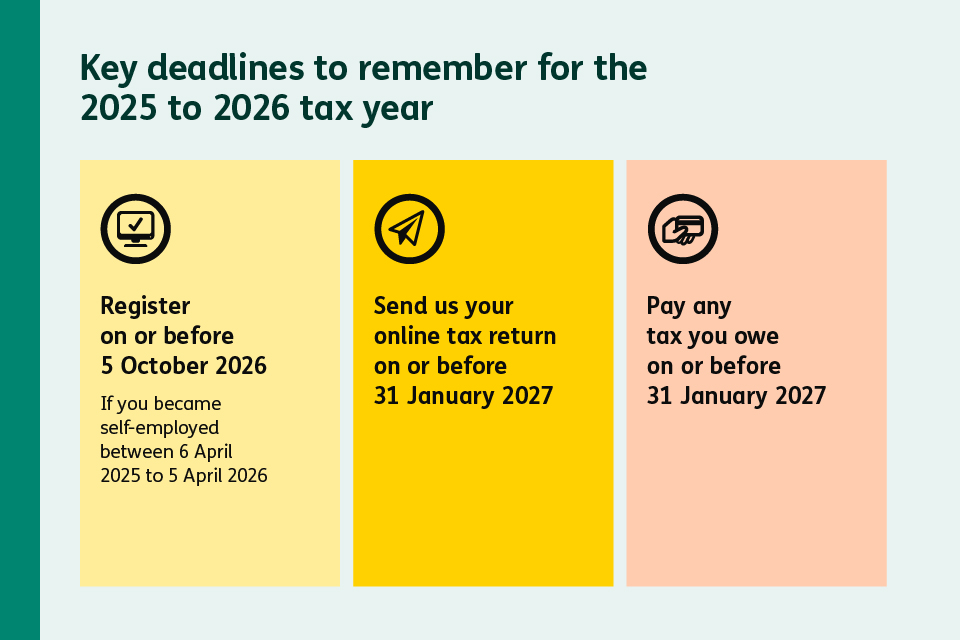
So, if you became self-employed sometime between 6 April 2025 and 5 April 2026, you need to tell us on or before 5 October 2026. You can tell us by registering for Self Assessment – check how to register for Self Assessment on GOV.UK .
The deadline for sending us your online tax return and paying any tax and National Insurance you owe is on or before 31 January after the tax year ends. This is the same deadline every year.
So, for the 2025 to 2026 tax year, you need to send us your online tax return and pay your tax bill on or before 31 January 2027 to avoid any penalties.
You can register for Self Assessment for free on GOV.UK.
Helpful tip:
It’s worth downloading the HMRC app on GOV.UK too to make your tax admin easier. You can check your tax info, set reminders, make payments, claim refunds and much more.
Send us your tax return online
Once you’ve registered, you’ll be given a Unique Tax Reference (UTR) number. You can see your UTR number on the HMRC app, or you can find it online on GOV.UK.
You can then start doing your Self Assessment tax return on GOV.UK. You’ll be guided every step of the way and, once you’ve sent it to us, you’ll see how much tax and National Insurance you owe for that year.
The quickest way to pay is through the HMRC app. You can find out how to download it and see other ways to pay your tax bill on GOV.UK.
Helpful tip:
If you’re not sure about doing a Self Assessment tax return, you can ask for help from someone such as an accountant or tax agent. You can find out more on GOV.UK.
Good record-keeping is important
You’ll find doing a tax return a lot easier if you keep a clear and regular record of the money coming in and going out of your business. This includes:
- any invoices you send
- receipts for things you buy for work
- bank statements
Learn more about how to do this in our Record-keeping for small businesses page.
Taking Self Assessment in your stride
Self Assessment might seem like a big task at first, but knowing the basics lets you break it down – and there’s plenty of support to help you get it right. Find out more on GOV.UK.
The information and resources on this site should help you get confident with the basics of tax, but you should always check the detailed guidance on GOV.UK for more help on doing your Self Assessment.