
Doing your Company Tax Return
If you run your own business, doing your taxes might seem like just another thing to add to your busy to-do list.
But if you have a limited company, it’s something you’ll need to be on top of, because you need to send us something called a Company Tax Return each year.
It might sound tricky, but getting to know the basics will help you handle it like a pro.
What a Company Tax Return tells us
In a nutshell, a Company Tax Return tells us how much money your business has made in a year, so we know how much tax your business owes.
The form to fill in is called a CT600 and it shows us things like:
- your company’s income
- any business expenses you paid for
- how much profit was made
‘Profit’ is what’s left of your company’s income once you’ve taken away anything you’ve spent on running the business (your company’s expenses) – like stationery or office furniture. You can find out more about what counts as a business expense on GOV.UK.
Helpful tip:
Sometimes, things called ‘reliefs’ and ‘allowances’ can also be taken off your profit before you pay tax. These are often used to help businesses grow and reduce their tax bill. There are lots of different types. You can find out which ones you might be able to claim on GOV.UK.
You’ll also need to include your company accounts and the sums done to work out your tax bill as part of your tax return. There are people who can help handle this for you, we’ll talk about them later.
Key thing to remember:
Even if your company made no profit, or didn’t even do any business, you may still need to send us a Company Tax Return.
Your company pays tax on any profits
If your company makes a profit, then it’ll need to pay something called Corporation Tax.
The rate depends on how much profit it has made.
Your company will pay 19% on profits under £50,000 – and 25% on profits over £250,000. If your company profits are between these two figures, the tax rate will be somewhere in the middle.
You do your Company Tax Return online
You can do the tax return yourself using an accounting software tool (we have a list on GOV.UK) or with the help of an accountant or tax agent. We’ll take a look at this later on.
Helpful tip:
You’ll need your company’s Unique Taxpayer Reference (UTR) to hand. Not sure what yours is? Find it by logging in on GOV.UK or on the HMRC app.
Get ahead of the game
It’s a great idea to start getting your Company Tax Return ready well before the deadline. Giving yourself plenty of time will help you collect all the info you need, check that everything’s right – and avoid any last-minute panics.
A professional can handle things for you
Many people like to use an accountant or tax agent. They can save you time, hassle and help make sure everything is spot on. If you do want someone else to handle things, you’ll need to allow them to get in touch with us about your tax on your behalf.
You can find information on how to choose an accountant or tax agent on GOV.UK.
Know your deadlines and stay on track
Your company’s ‘accounting period’ is the time covered by your Corporation Tax Return. It’s usually the same as its financial year. You can find out when yours is and what to do if it’s different on GOV.UK.
There are two big deadlines to remember.
1. You need to have filled in and sent us your Company Tax Return within 12 months of the end of your company’s accounting period.
2. You need to pay any Corporation Tax you owe earlier – within 9 months and 1 day of the end of your company’s accounting period.
Here’s how that might work
If your company’s accounting period (or financial year) ends on 31 March 2026, you need to have sent us your Company Tax Return on or before 31 March 2027.
And you need to have paid any Corporation Tax your company owes on or before 1 January 2027.
Even if you’ve shared your accounts with Companies House, you still need to send them to us as part of your Company Tax Return.
It pays to do things on time
There are fines for sending your Company Tax Return late. Getting it done before the deadline means your business won’t get charged.
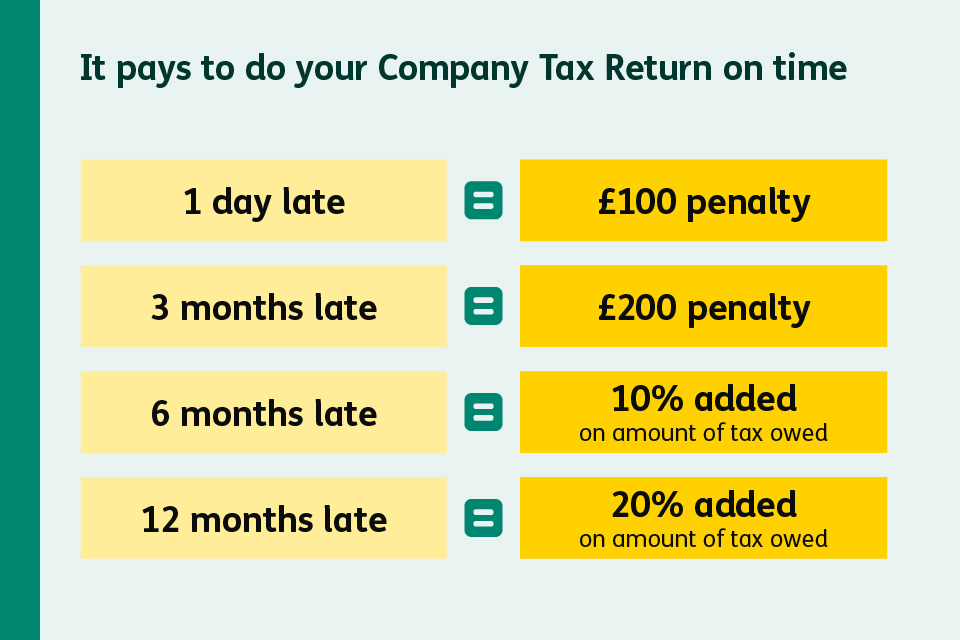
If the company is late 3 years in a row, those £100 penalties go up to £500. Your company will also be charged a penalty on any unpaid tax from the date the tax was due.
So you can see why staying on top of your Company Tax Return is so important.
You can do it yourself or ask for professional help from an accountant or tax agent, like we mentioned earlier.
Help and support is here
We know that running a business can be hard, so we’re here to help.
If your company can’t pay its tax bill on time, you can ask us about setting up a payment plan on GOV.UK. It lets you spread the cost over a few weeks or months.
If your company is charged a penalty and you think there’s a good reason for filing your company tax return late, you can get in touch to appeal. For instance, you may have had a serious illness or lost a loved one. If so, just give us all the details you can.
Once you’ve got to grips with the ins and outs of doing a Company Tax Return, you’ll be able to take it in your stride – so you can get back to doing business.
The information and resources on this site should help you get confident with the basics of tax, but you should always check the detailed guidance on GOV.UK for more help on doing your Company Tax Return.