
Tax in the food hospitality industry
If you’re running a food and hospitality business, you’ll need to make sure you understand some additional tax arrangements.
Whether you run a pub, café, restaurant or takeaway, we’re here to help you understand how tax works for your business – so you can stay on top of your finances, feel confident, and avoid any unwanted surprises.
Here, we’ll cover what you need to know about some of the more unique parts of the industry, like tips, VAT (Value Added Tax) and paying any seasonal staff.
How VAT works on food
VAT on food can seem confusing but, to put it simply, the rules change based on what the food is and how it’s served.
You need to add the standard 20% VAT to the price of any food and drink that you prepare for catering or takeaway, including:
- any meals eaten in your restaurant (including hot and cold food and drink)
- any meals eaten from your café at your tables (including hot and cold food and drink)
- any hot takeaways of food and drink
With takeaways, it matters whether the food is supposed to be eaten hot, or if it’s only hot because it’s just been cooked but is usually eaten cold.
Here’s an example.
You want to charge £2 for a sausage roll.
It’s sold hot, and it’s also supposed to be eaten hot.
So you need to charge £2 plus 20% VAT, making it £2.40 in total.
However, cold takeaway food that your customers eat elsewhere, is usually what we call ‘zero-rated’. That means you don’t need to add VAT. But there are exceptions that always have VAT charged at 20%, including:
- potato-based crisps
- sweets and chocolate confectionery
- ice cream
- soft drinks
- alcohol
Find out more about when to add VAT in this guide on GOV.UK.
VAT with tips and service charges
Working in food hospitality, your staff are likely to receive ‘tips’ or a ‘service charge’ from your customers. When it comes to VAT, it depends whether the payment is optional (the customer freely chooses to pay it), or mandatory (the customer has to pay it).
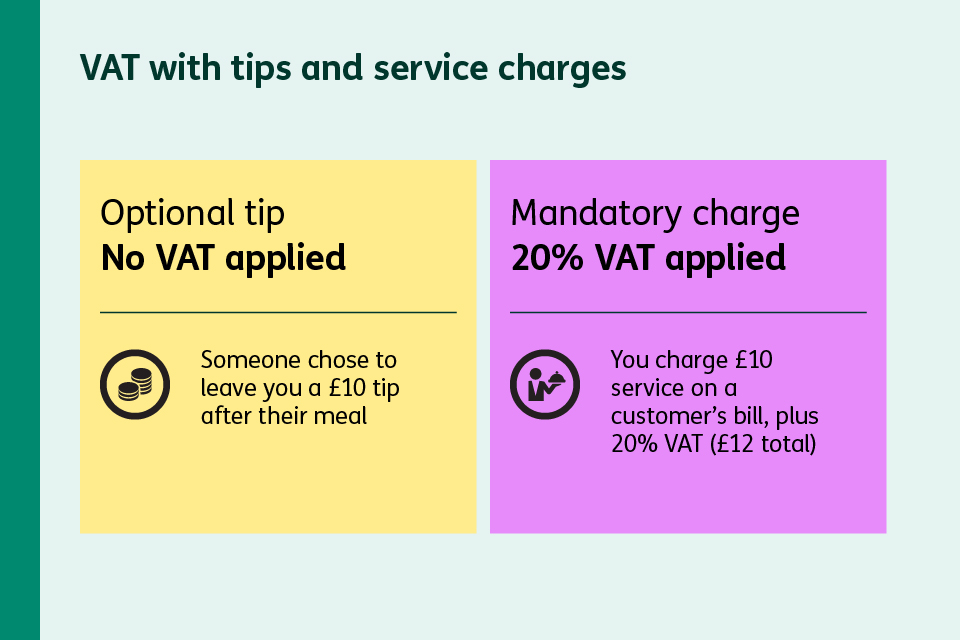
Tips are optional. The customer freely chooses to pay them, on top of their bill. You don’t need to add VAT to tips.
Service charges are mandatory. They’re added to the bill and customers have to pay them. Service charges are treated as part of your sale, so you do need to add 20% VAT on these.
Here’s an example.
Someone chose to leave you a £10 tip after their meal. There’s no VAT on that.
You charge £10 for service on a customer’s bill. You do need to add VAT as it’s mandatory – they haven’t chosen to pay it.
In this case, it would become £10 plus 20% VAT, making it a £12 service charge for the customer.
Key thing to remember:
If your customers have to pay a mandatory service charge, you need to add VAT. If your customers freely choose to leave an optional tip, then you don’t.
Other tax rules for tips and charges
You may not know this, but it’s the law that employers must pass all tips and service charges onto their staff.
These count as taxable income, but it’s how they’re handled that will decide how that tax is collected.
You don’t need to do anything if the tips and service charges:
- are paid directly by customers to your staff in cash
It’s your staff member’s job to tell us about them, so we can collect the right amount of tax.
You need to put tips and service charges through our Pay As You Earn (or PAYE for short) system if:
- they’re paid in cash and you collect them then share them out between staff
- they’re paid by card and you then pass them on to staff
This means the tips and service charges go straight into your staff’s wages, with Income Tax and National Insurance automatically taken off before they’re paid. You can learn more about how PAYE works on our Understanding PAYE and Employer’s National Insurance page.
Key thing to remember:
If you collect and share out tips and service charges, you need to put them through our PAYE system, whether they’re paid in cash or by card.
Using a tronc scheme for tips
Many food hospitality businesses use something called a ‘tronc scheme’. This is only for tips and can’t be used for any service charges. The main benefit is that, in most cases, National Insurance contributions don’t need to be taken from the tips, which means staff take home a bigger share.
Helpful tip:
Any money the customer pays over and above any mandatory service charges can also be included in the tronc scheme.
How a tronc scheme works
Step 1: Choose a troncmaster – this can be a member of staff or someone from outside the business, but can’t be the business owner.
Step 2: Let us know that a tronc scheme has been set up and the name of the troncmaster.
Step 3: The troncmaster needs to set up a new PAYE scheme – and keep a separate record for tips.
Step 4: The troncmaster collects all the tips together, whether they’re paid by cash or card.
Step 5: The troncmaster can use the employer’s software to run the tips through the PAYE scheme. This will automatically take off Income Tax. Staff are then paid their tips through PAYE.
You can find more information on setting up a tronc scheme on GOV.UK.
Key thing to remember:
You, as the business owner, cannot be the troncmaster.
The costs of employing staff
First things first, you’ll need to make sure all your staff are paid at least the National Minimum Wage or National Living Wage, details can be found on GOV.UK.
Then, you’ll need to start collecting Income Tax and National Insurance from your staff’s wages if they:
- are paid £96 or more a week
- get expenses or benefits from you, like a company phone
- have another job
- get Jobseeker’s Allowance, Employment and Support Allowance, or Incapacity Benefit
You’ll also need to pay something called Employer’s National Insurance.
Paying wages, collecting Income Tax and National Insurance, and paying your own Employer’s National Insurance is called ‘running a payroll’.
You can learn more about how it all works on our Understanding PAYE and Employer’s National Insurance page.
Helpful tip:
If you have up to 9 employees, you can use our Basic PAYE Tools to manage your payroll. This is free software that helps you work out what tax to take off and keeps us in the loop automatically. You can find out how to download, install and run Basic PAYE tools on GOV.UK.
Seasonal and casual staff
Many food hospitality businesses take on extra staff during busy periods like Christmas or summer. Or you might have casual staff that only work every now and then.
Even if someone only works for you for a few weeks, you still need to put them on your payroll. You’ll need to make sure you’re paying either the National Minimum Wage or National Living Wage, and you’re taking Income Tax and National Insurance through their pay – just like with regular staff.
Most employers do this through the PAYE system we’ve talked about earlier. You can find out more on our page about tax for employers.
Getting it right from the start
We hope this has helped you get a better understanding of the rules for food hospitality and can prevent any unexpected surprises when it comes to dealing with tax for your business.
If you’re not sure about anything else, you can find more help for employers on GOV.UK.
Tell us what you think
We welcome your input to help us improve this website. Please take a few moments to complete our short website feedback survey about your experience.
The survey is anonymous, does not collect personal information, and consists of five optional rating questions.