
Getting to grips with Corporation Tax
If you run a limited company in the UK, your company will need to pay something called Corporation Tax on any profits. This isn’t the same as Income Tax, which people pay on their wages.
We’re here to help you understand how it works, so you’ll feel more confident about this part of running a business.
Your company pays Corporation Tax on profits
When your company makes money, it pays tax on the profit. ‘Profit’ is what’s left of your company’s income once you’ve taken away anything you’ve spent on running the business (your company’s expenses) – like stationery or office furniture. You can find out more about what counts as a business expense on GOV.UK.
Your limited company’s income could come from selling products (goods) or services, or making investments.
Here’s an example:
Company A makes £100,000 in an accounting period (financial year).
The company spent £60,000 buying stock.
It spent £25,000 on running costs like rent, utility bills and insurance.
The company takes away the £60,000 and £25,000 from its income.
This leaves it with £15,000 profit. It’ll pay Corporation Tax on that £15,000.

Finding out who pays Corporation Tax
A lot of different companies and organisations may have to pay Corporation Tax, such as:
- limited companies – this includes all UK companies registered with Companies House
- foreign companies that do business in the UK through a local branch or office
- clubs, community groups and similar organisations – if they make a taxable profit
Key thing to remember:
Sole traders don’t pay Corporation Tax. If you take money out of your limited company to pay yourself a salary or dividends (or in the form of a loan), you may pay Income Tax on that amount.
Your company’s profit determines the rate of tax
The amount of Corporation Tax your company pays depends on its profits. It will pay:
19% on smaller profits up to £50,000
25% on larger profits over £250,000
Here’s an example:
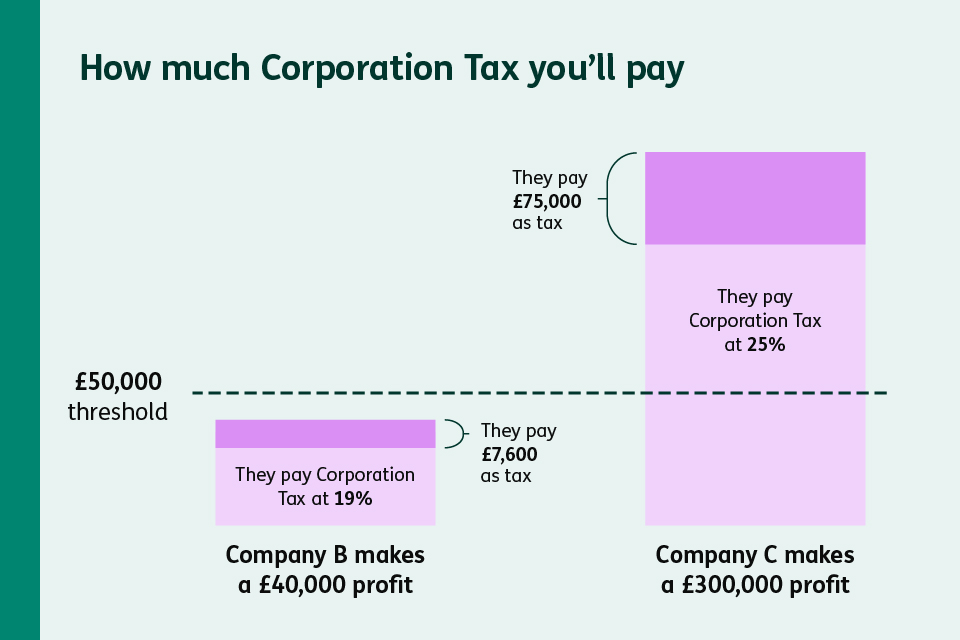
The small cleaning company, Company B, makes a £40,000 profit.
They pay Corporation Tax at a rate of 19%.
This means they pay £7,600 as tax – which is 19% of £40,000.
The large printing business, Company C, makes a £300,000 profit.
They pay Corporation Tax at a rate of 25%.
This means they pay £75,000 as tax – which is 25% of £300,000.
If your company makes profits of anywhere between £50,000 and £250,000, something called ‘marginal relief’ kicks in. It sounds complicated, but it simply means that the rate of tax paid slowly increases step by step from 19% to 25%.
So, if your company only made a little over £50,000 in profit, it wouldn’t be paying the full 25% rate straight away.
You’ll send us a Company Tax Return
Unlike some taxes, we won’t send you a bill for Corporation Tax.
Instead, you work out how much your company owes and then pay it to us. This is done by filling out a Company Tax Return.
Learn more about it on our Company Tax Return page.
Many business owners use an accountant or tax agent to help with their tax returns.
Key thing to remember:
If you do employ someone to help do your tax returns, it’s still down to you as the company director to make sure the tax is right and paid on time.
Getting set up for Corporation Tax
If you run a club, community group or a similar organisation, you’ll need to register for Corporation Tax in a different way. If this sounds like you, find out how to register on GOV.UK.
Helpful tip:
When you register your company with Companies House, you can set up your business tax account with us at the same time. This means you’ll be able to look after everything easily online, from doing your tax returns to making any payments.
Get tax confident
Getting your head around Corporation Tax is an important part of running a limited company. We’re here to help fill any gaps in your knowledge, so you can set your business up for success.
3 key things to remember
Your company only pays Corporation Tax on its profit
The rate paid is determined by how much profit it makes
It’s up to you to work out and pay the right amount of tax
For full guidance on registering for Corporation Tax, filing your Company Tax Return and paying your bill, visit Corporation Tax on GOV.UK.