
Choosing your business structure
Starting a business is exciting. But before you get going, you’ll need to decide how you want to set it up. This is called choosing a business structure.
Your choice affects three big things:
How much tax you pay
How much admin you need to do
What happens if things go wrong
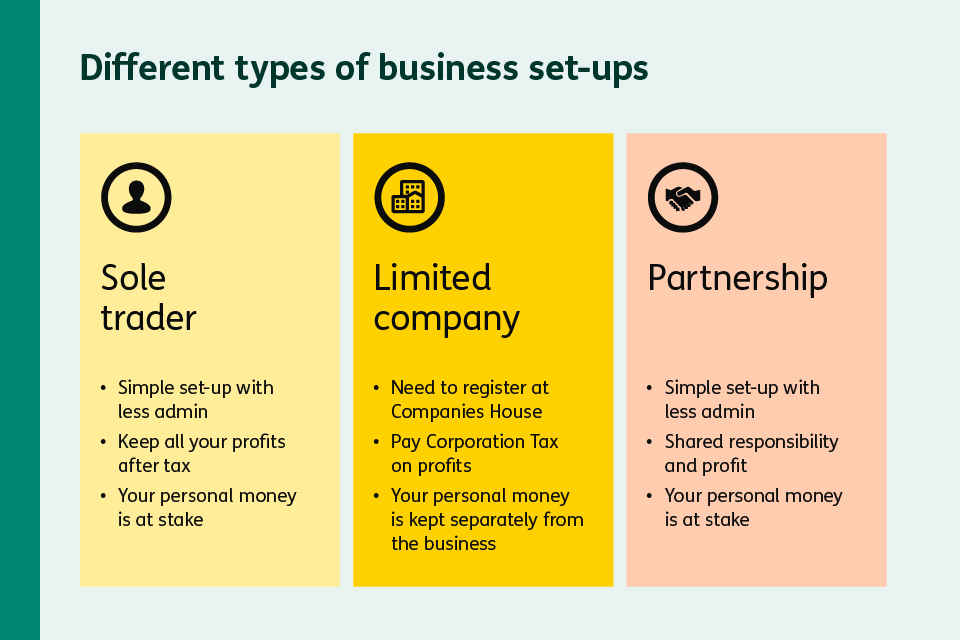
Most people only have three options to pick from – a sole trader, a limited company or a partnership – and you can always change later if your business grows or your circumstances change.
Whichever route you choose, the important thing is that you understand how each structure changes how you need to handle tax. That way, you can make a choice that fits your plans and gives you confidence as you build your business.
Sole trader: the simplest way to start
This is how most people start out.
Key thing to remember:
Being a sole trader means you run your business by yourself. It also means you and your business are legally the same in the eyes of the law.
It’s quick and free to set up. You just register with us for something called Self Assessment and will fill out a tax return each year.
There’s no fee to pay, you keep all your profits after tax, and you’re in charge of every decision.
However, it does mean if things do go wrong and your business gets into any money trouble, then your personal cash and belongings could be at risk.
You can find out more on our Setting up as a sole trader page.
Key thing to remember:
As a sole trader, the way you send us information about your income is changing. It’s called Making Tax Digital for Income Tax. For some people that change starts from April 2026.
Making Tax Digital for Income Tax works differently to Self Assessment. You should check if the different rules apply to you. Find out who needs to use it, when to start, and how you can get ready for it on our Making Tax Digital for Income Tax page.
Limited company: keeping your business separate
Setting up a limited company is very different to being a sole trader.
Key thing to remember:
It keeps your business separate from yourself – so your personal money is separate from your limited company. The company, rather than you, can own things, owe money, and agree to contracts in its own name.
The main benefit of this is something known as ‘limited liability’. This means that if the company runs into any money trouble, your personal savings, belongings and home are usually protected. You can only lose whatever money you’ve put into the company.
A limited company is taxed differently to sole traders and partnerships. Your company will need to pay Corporation Tax based on how much profit it makes. And you, as an individual, will need to pay Income Tax on any money you take from the business (such as your wages).
Find out more on our Getting to grips with Corporation Tax page.
To set up a limited company, you need to register with Companies House – there’s a form to fill in and a small fee that you’ll need to pay. You’ll also need to register with us.
You can find out more on our Setting up a limited company page.
A partnership: running a business with others
If you choose this business set-up, then each partner will need to register with us individually, fill in their own tax return, and pay tax on their share of the profits. One partner will also need to send us a Partnership Tax Return for your business.
You can find out more about setting up a partnership on GOV.UK.
Key thing to remember:
A partnership is when two or more people choose to run a business together. You share the work, the profits, and the decisions.
Helping you make the right choice
There’s no single right answer and none of these business set-ups are better than the other. It all depends on what matters most to you.
It’s important to look closely at the different types of business structure so you can choose the one that best fits you and your business needs.
It’s also handy to know that you can change your business structure as your business grows. This is perfectly normal as business needs can change over time.
You can explore the different structures we’ve talked about and find out more about setting up a business on GOV.UK.